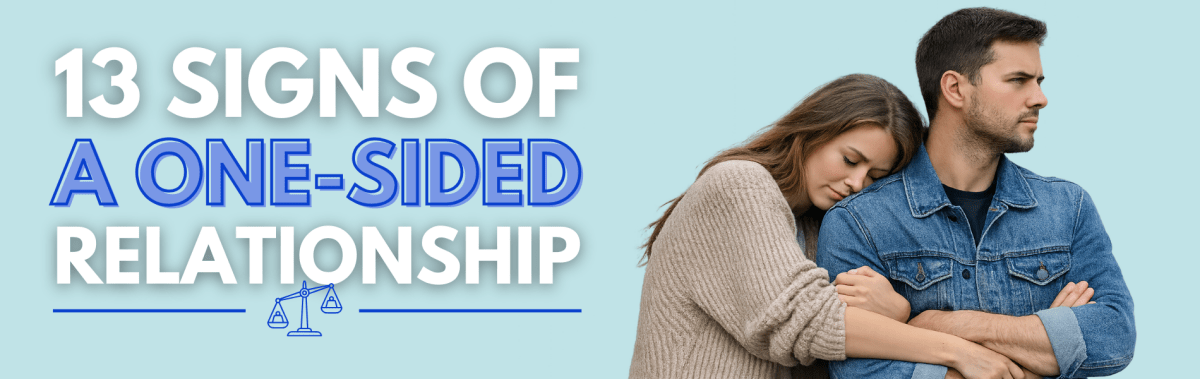
You love. You show up. You try. But somewhere along the way, you started wondering is any of this actually coming back to you? There's a specific kind of exhaustion that comes from loving someone who doesn't quite meet you halfway. It doesn't always look like obvious neglect. Sometimes it just feels like a slow, quiet drain on your energy, your self-esteem, and your sense of worth.
If you've been carrying this relationship mostly on your own and you're starting to ask yourself whether it's in your head, it's probably not. This article breaks down 13 signs you're in a one-sided relationship, what causes it, why people stay, and when it's time to let go.
What Is a One-Sided Relationship?
A one-sided relationship is a kind of relationship where one person invests significantly more time, emotional energy, and effort than the other. It's not about keeping score, all relationships have seasons where one partner carries more weight. But when that imbalance becomes the permanent dynamic, it stops being a rough patch and starts being the relationship itself. One person is all in. The other one is… somewhere else.

13 Signs That You Are Alone In a Relationship
#1 You're Always the One Initiating
Think about the last ten times you connected with your partner. Who reached out first? Who planned the date? Who sent the "are you okay?" text after a rough day? If the answer is always you, that's a sign worth paying attention to.
Some examples that might feel familiar:
- You send the first message every single morning
- You're the one proposing when to go out
- You revive conversations they let die
- You call — they rarely call back
- You plan everything, down to the details they don't notice
You stop initiating as an experiment, and days go by in silence. That silence tells you everything.

#2 You Feel Emotionally Drained Instead of Supported
A close relationship should give you energy sometimes, not just take it. But when spending time with your significant other consistently leaves you more depleted than before, something is off.
You go into the conversation needing support. You come out having managed their emotional state, reassured their ego, or avoided a disagreement to keep the peace. Your own feelings? Still sitting on the table, untouched. Over time, this takes a real toll mentally, physically, emotionally. You start to feel like you exist in this relationship to serve a function, not to be loved.
#3 You Feel Lonely Even When You're Together
This one is particularly painful. At least absence has an explanation. But loneliness in someone's presence cuts differently.
You spend time together, but still feel emotionally alone. You're sitting right next to them, and you've never felt further away. You could say something vulnerable right now, and you already know it wouldn't land. So you say nothing. And the emotional distance grows.

#4 Conversations Feel One-Sided
In a one-sided relationship, conversations have a predictable shape. They talk about themselves at length. When you start sharing something, the subject shifts back to them within minutes. They don't ask how you feel. When you mention something stressful, they respond with something about their own day.
You walk away feeling like a supporting character in a story that isn't yours. Your desires, your emotional state, your needs, these aren't really part of the dialogue.
#5 They Only Show Effort When You Pull Away
You've probably noticed the pattern. Things feel flat, you pull back and suddenly they're attentive, almost like the person you fell for. You feel hopeful. You lean back in. Two weeks later, it's back to how it was.
Their effort isn't a sign of genuine change, it's a response to the fear of losing you. The moment that fear fades, so does their motivation. It's not love. It's maintenance.

#6 You Walk on Eggshells Around Them
You want to tell them something's bothering you. But first, you mentally run through every way it could go wrong. Will they get defensive? Will it turn into a blaming spiral? Will you end up comforting them for being upset about your feelings?
So you say nothing. Again. You say yes when you mean no. You downplay what you feel to avoid the fallout. This kind of self-erasure is slow, but it's corrosive and it's a sign that emotional safety in this relationship only runs one direction.
#7 Your Needs Always Come Second
There's always a reason why now isn't a good time. They're stressed. They've got a lot going on. So you wait, adjust, and shrink what you need into something more manageable.
But that smaller version of your needs still doesn't get met. Compassion for your partner is beautiful. Compassion that only ever runs toward them and never back to you isn't balance, it's self-abandonment dressed up as love.

#8 You're Carrying the Emotional Weight of the Relationship
Psychologists call this "emotional labor", the invisible work of managing feelings, maintaining connection, and keeping the relationship functional. In a healthy relationship, both partners share that load.
A 2005 study published in the Journal of Marriage and Family found that when emotional labor is unequally distributed in a couple, resentment builds and marital burnout follows. When only one person is doing this work consistently, the relationship doesn't just feel unbalanced, it measurably deteriorates.
#9 You Keep Making Excuses for Their Behavior
Your friend asks how things are going. "Good" you say. "He's just been really stressed at work." Or: "She's not great at expressing affection, it's just how she grew up."
There's a difference between understanding your partner's context and using it to excuse a consistent pattern of no reciprocation. When your empathy is working overtime to justify why someone keeps falling short, ask yourself: are you protecting them, or are you protecting yourself from seeing clearly?
#10 You Stop Sharing Your Real Feelings
You used to tell them things. Real things. But you learned that vulnerability here doesn't go where you hoped. You opened up and they changed the subject. You shared something painful and they seemed annoyed.
So you stopped. You now show a curated, careful version of yourself and the real you is having a whole separate internal experience your partner knows nothing about. That's not intimacy. That's isolation inside a relationship.

#11 They Avoid Difficult Conversations
They go quiet when things get hard. They say "can we not do this right now?" and right now never comes. Or they turn the conversation into an argument where you end up managing their reaction instead of addressing the actual issue.
Effective communication requires both people to show up. When only one is willing to sit at the table, the relationship's problems just keep stacking up with no way through.
#12 You Constantly Question Your Worth
This is the sign that does the most lasting damage. When someone who's supposed to love you keeps falling short, the brain doesn't always conclude "they're not showing up." It concludes: "maybe I'm not worth showing up for."
You wonder if you're too needy, too sensitive, too much. Low self-esteem in relationships rarely appears out of nowhere. It's often built, slowly, by being on the receiving end of someone's indifference.

#13 You Keep Hoping They'll Become the Person They Were at the Beginning
You remember who they were; the attention, the warmth, the way they made you feel seen. And you keep waiting for that person to come back.
But people show you who they are consistently over time. The beginning of a romantic relationship is almost always its most effortful phase. If who they are now, on most days, not just the good ones, isn't working for you, hoping for a change that isn't happening is just a way of staying in something that's hurting you.
What Causes an Unbalanced Love?
One-sided relationships don't usually start that way on purpose. Attachment styles play a big role. Someone with an avoidant attachment style may genuinely struggle with emotional intimacy, not because they don't care, but because vulnerability feels threatening. On the other side, someone with an anxious attachment style may over-give as a way of securing love they fear losing. These two often find each other, and the result is a painful cycle where one person chases and the other retreats.

Past bad relationships and fear of abandonment also matter. And sometimes, it's simply a mismatch in emotional availability. One person is ready for a long-term relationship, the other isn't, and neither has said it out loud.
Why People Stay When Love is One-Sided
A close friend of mine (the kind of person who gives everything in a relationship) spent nearly 8 years in a one-sided marriage. When I asked why she stayed so long, she didn't hesitate.
"Because I kept thinking it was my fault" she said. "If I was just more patient, more understanding, maybe he'd open up. And when things were good, they were really good. Those moments made me feel like I wasn't crazy for staying."
Guilt keeps people in unhealthy relationships the feeling that leaving means giving up on someone who needs them. So does the fear of loneliness, which makes a one-sided relationship feel safer than none at all. And then there's the sunk cost: the years, the history, the shared life that makes walking away feel like losing something irreplaceable. Sometimes it's just love, plain and simple. Loving someone and knowing the relationship isn't working are two things that can be true at the same time.
How to Fix a Single Sided Relationship?
An imbalanced relationship can shift but only if both partners are honest and willing to do the work.
Name the problem clearly. Stop softening the conversation to protect their feelings. Tell them specifically how you feel: "I feel emotionally unsupported when I share something and you don't engage." That's not an attack, it's self-disclosure, and it gives them something real to respond to.
Stop over-functioning. When you do everything, you remove any incentive for them to step up. Pull back from some of the emotional labor you've been carrying alone, not as punishment, but as honest recalibration.
Set expectations with real consequences. "I need more from you" needs to be followed by something concrete. "If things don't change, I need to seriously reconsider this relationship" isn't a threat, it's honesty.
Consider couples counseling. A counselor can help both partners see the dynamic more clearly and build the communication skills to address it. If your partner refuses, that refusal is also information.

And sometimes, rebuilding starts with the smallest gestures, choosing to do something together, just for the sake of it. Even something as simple as wearing couple hoodies can be a quiet way of saying: we're choosing each other today.
When It's Time to Stop Loving Someone Alone
If you've communicated your needs clearly and nothing has changed. If this relationship makes you feel worse about yourself than you did before it, that's not love working. If you've had the conversations, tried the counseling, given it real time and you're still the only one truly in it then staying isn't loyalty. It's hoping at the cost of your own well-being.
Letting go of a one-sided relationship isn't giving up on love. It's making room for the kind that actually comes back to you. You deserve a relationship where both partners show up not perfectly, but genuinely. Where your needs aren't an inconvenience. Where you don't have to earn affection by disappearing.
Ask yourself, honestly: are you in a relationship? Or are you in love, alone?